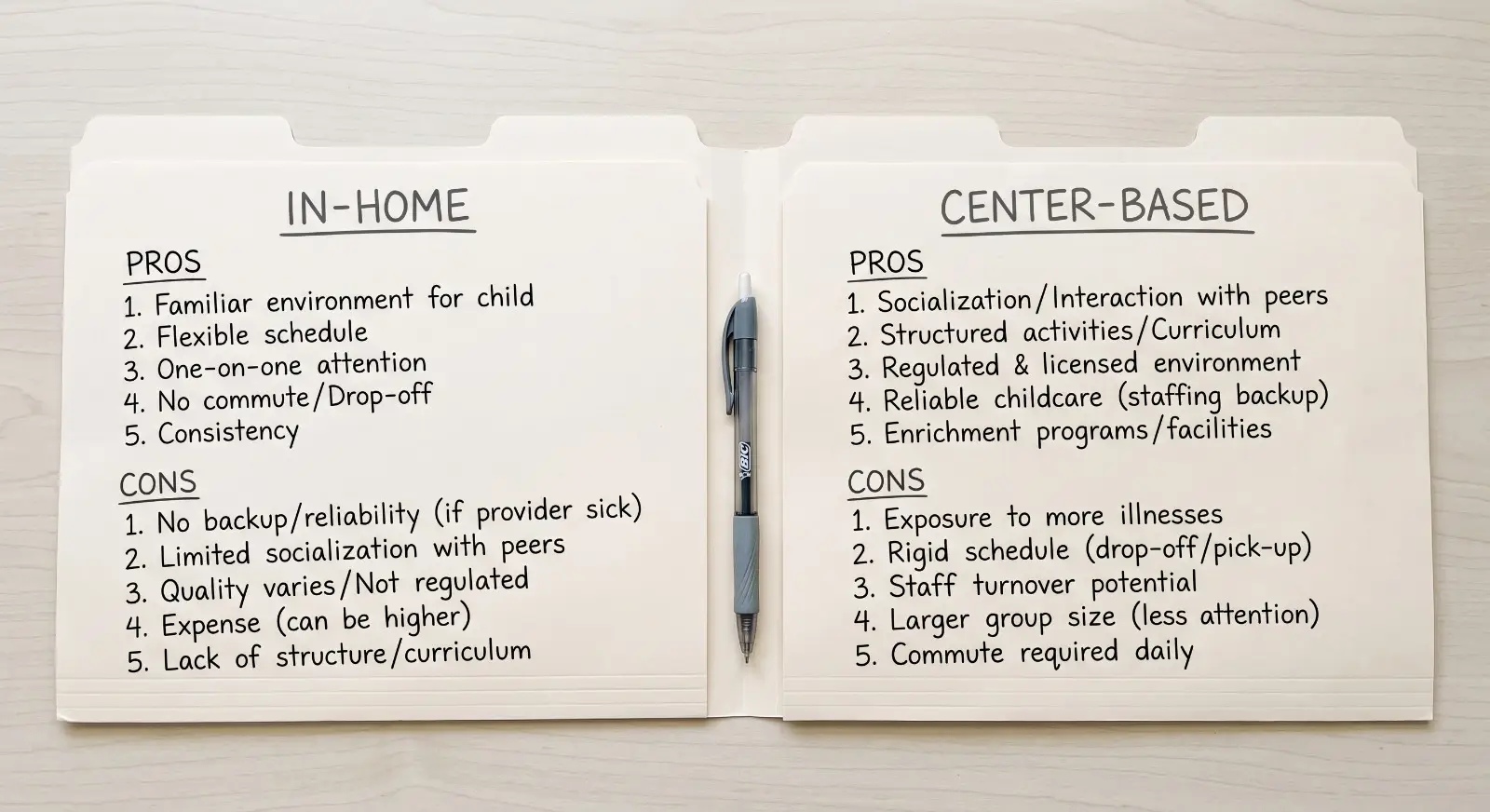
If you’re trying to choose between in-home and center-based ABA therapy, the best option usually depends on what your child needs most right now. In-home ABA can be a strong fit when everyday routines, family coaching, and real-world carryover matter most. Center-based ABA can make more sense when structure, fewer distractions, and peer interaction are the bigger priorities. For some families, a blended path ends up being the best fit.
Even with that short answer, this can still feel like a big decision. You’re not just comparing two service models on paper. You’re thinking about your child’s goals, your family’s schedule, commute time, stress level, and what kind of support feels realistic in daily life. The good news is that this does not have to be a forever decision. The right starting point can change over time, and that is completely normal.
A quick side-by-side look
A helpful starting question is simple: where does your child need support most, and what kind of setting is most likely to help those skills stick?
Quick comparison
- Environment: In-home ABA happens in familiar routines and spaces. Center-based ABA happens in a dedicated therapy setting.
- Structure: Center-based care often offers more predictable routines and fewer household distractions.
- Social opportunities: Center-based care may create more chances for peer interaction.
- Parent involvement: In-home ABA usually makes caregiver coaching easier to build into sessions.
- Carryover into daily life: In-home ABA can make it easier to practice skills where challenges already happen.
- Logistics: In-home care reduces travel. Center-based care keeps therapy separate from home life.
- Best fit: In-home may be better for routine-based goals. Center-based may be better for children who benefit from a more structured setting.
If your family is leaning toward home-based support, this overview of in-home ABA in North Carolina gives a clearer picture of what that path can look like.
What each setting may support best
In-home ABA may be the better fit when…
In-home ABA often makes the most sense when the biggest challenges are happening in everyday life. That might mean communication during meals, getting ready for school, toileting, sibling interactions, dressing, or handling changes in routine. Because therapy happens where those moments actually occur, it can be easier to build skills that carry over into the rest of the day.
This setting can also give parents more direct coaching and support. For many families, that feels less like dropping into a separate program and more like having a knowledgeable hand to hold while working through real situations at home. It can be especially helpful for younger children, but it can also support older kids who are working on independence at home or in the community.
That does not mean in-home ABA is automatically more effective. It simply may be a better fit for certain goals, certain family routines, and certain stages of development. If you’d like a broader picture of how home-based services work, this look at in-home ABA is a useful next read.
Center-based ABA may be the better fit when…
Center-based ABA can be a strong option when a child benefits from more structure, fewer distractions, and a setting built specifically for therapy. It may be a good fit for children working on transitions, attention, school-readiness, or social learning in a more predictable environment.
Some families also appreciate the separation between therapy and home life. A center can make it easier for a child to practice following routines, moving between activities, and engaging in peer opportunities that may be harder to recreate at home.
There are tradeoffs, of course. Travel can add stress, and some goals may still need extra support to carry over into everyday family routines. Center-based care is not inherently better than in-home care. It is simply a different environment, and for some children, that environment works better. If you’re comparing providers, this guide to evaluating ABA centers can help you ask better questions.
The CARE-FIT Map: How to choose the best fit right now
The CARE-FIT Map is not meant to box your family into one answer. It is a simple way to sort through a decision that can otherwise feel overwhelming.
C: Child profile and current pressures
Start with what your child needs most right now. Think about communication, sensory load, safety, transition tolerance, attention, and where the hardest parts of the day tend to happen.
A toddler who struggles with dressing, mealtime, or leaving the house may benefit from support inside those exact routines. A school-age child who does better with more structure or more chances to practice social skills may do well in a center. Older children may need support tied to independence, flexibility, and community participation.
The main question is not which model sounds better in general. It is where your child is most likely to learn, practice, and feel supported right now.
A: Adult capacity and coaching needs
Family sustainability matters more than many people expect. In-home ABA can work beautifully when caregivers want hands-on coaching and the household has the capacity to support regular sessions. It can be harder when privacy is limited, schedules change constantly, or home already feels stretched thin.
That does not mean a family is doing something wrong. It simply means real life matters. Sometimes the option that looks best on paper is not the one a family can consistently maintain. Choosing the setting your household can realistically support is often part of choosing the setting that helps a child make steady progress.
R: Routines and real-world carryover
Ask yourself whether the biggest goals need to improve inside daily routines right away. If the pressure points are mealtime, bedtime, toileting, getting out the door, or community outings, home-based care may offer the most direct practice.
That kind of support can be especially meaningful for families who want skills to show up where life is actually happening, not only during therapy time. If that is a major priority for your family, this closer look at ABA and daily routines may be helpful.
E: Exposure and environment match
Some children feel calmer and more open to learning in familiar surroundings. Others do better in a space that is set up for structure, predictability, and fewer interruptions. This is also where peer exposure becomes part of the conversation.
If social learning is a major goal, center-based care may offer more natural opportunities to practice with others. If comfort, routine-based learning, and coaching within daily life matter more, in-home care may feel like the better match.
FIT: Fit for now, not forever
This part matters. The best starting point is not always the forever model.
Some children begin with in-home support because it feels more comfortable and helps the family build momentum in everyday routines. Later, they may benefit from a center’s structure or peer interaction. Other children start in a center and later need stronger carryover at home or in the community.
The goal is not to pick the one perfect model for all time. The goal is to choose the best fit for now and stay open to change as needs evolve.
In-home vs. center-based ABA fit worksheet
Use this worksheet before intake calls or provider comparisons.
| Focus Area | In-Home | Center-Based | What this means for our family |
| Therapy goals and carryover | Daily routines, communication, parent coaching | Structured practice, transitions, social learning | Where do we need change to show up first? |
| Parent involvement | Usually more direct and visible | Often less immediate during sessions | How involved can we realistically be each week? |
| Social and sensory needs | Familiar setting, but more home distractions | More predictable setup and easier peer exposure | Which environment helps our child learn best? |
| Scheduling and travel | Less commuting, more household coordination | More commuting, therapy stays separate from home | Which option is more sustainable for our family? |
| Home and sibling impact | Sessions happen inside family life | Therapy stays outside the household | How much activity can our home absorb? |
| Provider questions | How are goals chosen? How is parent training handled? | How is supervision structured? When do you recommend changing settings? | What answers do we need before deciding? |
Which model may fit best for your child and family right now?
Younger children and early-intervention families
For younger children, in-home ABA often feels like a natural fit when parents want support around communication, routines, and consistency in a familiar setting. It can be a gentle way to build skills in the places where daily life already happens.
That said, some younger children still benefit from a center-based setting, especially when structure, attention, or early social exposure need more support.
Elementary-aged children balancing home, school, and social growth
This stage often comes with more moving parts. Center-based ABA can help when structured practice and peer interaction are the biggest priorities. In-home ABA can help when families need stronger carryover into mornings, homework routines, behavior support, or everyday transitions at home.
For many children at this age, the question is less about one setting being better and more about where support needs to show up most clearly.
Older children with independence and community-based goals
Older children may need help with self-management, communication, flexibility, and community participation. Either model can work. The better choice usually depends on where the child is getting stuck and where new skills need to be practiced.
For one child, that may mean home and community routines. For another, it may mean a more structured setting first, followed by support with carryover elsewhere.
Family logistics can change the best answer
Sometimes the option that seems best from a clinical standpoint is not the option that fits real family life. Commute time, work schedules, sibling needs, privacy, and household stress all matter. So does caregiver bandwidth.
If you’re thinking through how involved you can realistically be, this article on why parent training matters is worth your time. If your family is just getting started, this guide to the first 30 days of ABA can also help set expectations.
When a hybrid or transition plan may make more sense
Some families do not stay with one model forever, and they do not need to. A child might begin with in-home ABA to build comfort and support routines at home, then later benefit from more structure or peer interaction in a center. The reverse can happen too, especially when progress made in a center needs stronger follow-through at home.
It may be time to revisit the service model if goals have changed, routines are still breaking down, travel has become too hard to sustain, or your child seems to need a different kind of environment in order to keep moving forward.
These changes should be thoughtful and individualized, not abrupt. If your family is trying to support carryover across settings, this piece on transitions between home, school, and community offers helpful context.
Questions to ask ABA providers in Minnesota and North Carolina
A strong provider should be able to explain not only what they offer, but why they recommend a certain setting for your child.
Questions like these can make the decision feel clearer:
- How do you decide whether in-home, center-based, or blended care is the best fit for a child?
- How are goals personalized around the challenges happening in our child’s current setting?
- What does parent training or caregiver collaboration actually look like?
- How do you measure progress across settings?
- How is BCBA supervision handled?
- If we start in one model, what signs would tell you it is time to shift or blend services?
- For Minnesota families, how do you help with access questions related to EIDBI, CMDE, Medical Assistance, or MinnesotaCare?
- For North Carolina families, what should we ask about travel radius, clinician availability, and insurance coverage for in-home care?
If home-based support feels like the right direction, our North Carolina in-home ABA page is a strong next step. Families comparing access and cost may also find this overview of ABA coverage and insurance and these North Carolina financial support options helpful.
FAQ
What are the benefits of in-home ABA therapy?
In-home ABA therapy can support real-life skill practice, stronger carryover into family routines, and more direct parent coaching. It may be especially helpful when the biggest challenges are happening during daily activities at home or in the community.
How does center-based ABA therapy differ from in-home therapy?
The biggest difference is the setting. Center-based ABA usually offers more structure, fewer household distractions, and more opportunities for peer interaction, while in-home ABA focuses more directly on routines, family coaching, and skill practice in natural settings.
Which is more effective: in-home or center-based ABA therapy?
Neither model is automatically better. Effectiveness depends on your child’s profile, the goals being worked on, your family’s capacity to support the plan, and the quality of the provider’s care.
What factors should parents consider when choosing between in-home and center-based ABA therapy?
Parents should look at child needs, caregiver bandwidth, daily routines, travel demands, social goals, home distractions, and where they need progress to show up most clearly. The CARE-FIT Map can help organize those factors in a more grounded way.
Can a child transition from in-home ABA to center-based therapy or combine both?
Yes. Some children start in one setting and later transition or blend services as goals change. The strongest transitions are individualized, planned with the provider, and coordinated so progress carries across environments.
If your family is still sorting through the options, Alight ABA can be a supportive next step. The goal is not to force one path. It is to find the kind of support that fits your child and your day-to-day life with as much clarity, warmth, and confidence as possible.