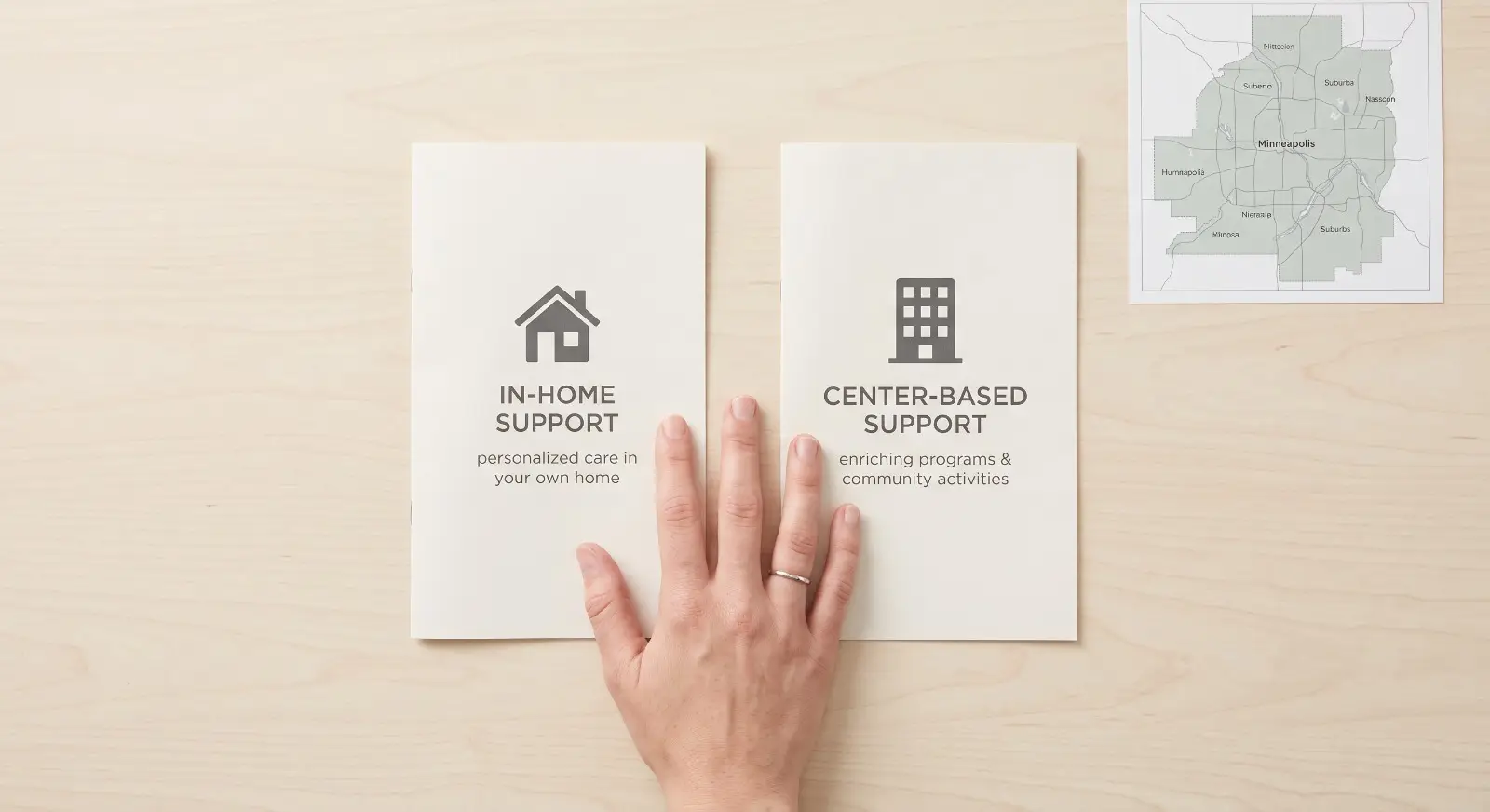
If you are comparing ABA therapy Minneapolis MN options, it can be hard to tell whether in-home or center-based support is the better next step. Most families are not looking for a perfect-sounding program. They want care that fits their child’s needs, their daily routine, and the realities of life in Minneapolis. ABA therapy uses evidence-based strategies to build communication, daily living, social, and safety skills, but the setting matters because it shapes how those goals are practiced.
In-Home vs. Center-Based ABA in Minneapolis: What Each Setting Helps With
In-home ABA is often a strong fit when the biggest challenges happen during real family routines such as getting dressed, mealtimes, school transitions, bedtime, or community outings. It also gives caregivers more direct coaching and can reduce travel strain, which matters for Twin Cities families balancing work, sibling schedules, and winter weather.
Center-based ABA can be helpful when a child benefits from a more structured environment, predictable learning blocks, and practice handling transitions outside the home. Depending on the provider, it may also offer more opportunities for peer interaction and tolerance for a clinic-style routine.
Neither setting is automatically better. Younger children may benefit from support built into home routines and parent participation. School-age children may need help with after-school regulation, generalizing skills between home and school, or managing a long day without adding another difficult commute. Older children and young adults may need more independence-focused goals, community practice, or a setting that matches their tolerance for structure and change.
ROUTE Fit Framework
R – Routines
Start by looking at where support is needed most. If the hardest parts of the day are mornings, homework, mealtimes, bedtime, or outings, in-home or community-based care may provide more useful practice.
O – Opportunities for Practice
Match the setting to the goal. A child who needs support using skills at home may need natural-environment practice, while a child who benefits from structured teaching or peer exposure may do better with some center-based time.
U – Understanding Regulation
Think about how your child handles noise, unfamiliar spaces, transitions, and new expectations. Some children regulate better in a familiar home environment. Others do well with the predictability of a structured center.
T – Time, Travel, and Caregiver Bandwidth
A plan has to be sustainable. Consider commuting across Minneapolis or the wider Twin Cities, daycare or school handoffs, sibling logistics, and how weather disruptions could affect consistency.
E – Eligibility, Expertise, and Support
Before choosing a provider, ask how BCBA oversight works, how goals are selected, how parent coaching is handled, and what support is available around Minnesota requirements such as EIDBI, CMDE questions, Medical Assistance, MinnesotaCare, or private insurance verification.
What in-home ABA actually looks like in Minneapolis
Most Minneapolis families we work with choose in-home sessions, and the reason is usually practical rather than clinical. Winter makes a twice-weekly drive across the city a real commitment, and a child who has already spent a day at school has very little left for a car journey. Sessions at home also happen in the rooms where the difficulty actually is: the morning routine, the kitchen at dinner time, the bedtime that takes two hours. A center has its own advantages, particularly where a child needs to practice being around other children before starting school, and some families use both. What decides it is usually the goals rather than the preference, and the CMDE is where those get set. If you want the detail on how our Minnesota program runs, it is on our in-home ABA therapy in Minnesota page.
Minneapolis ABA Setting Match Grid
Use this quick grid during intake calls so you can compare providers side by side.
| Decision Area | In-Home ABA | Center-Based ABA | Questions to Ask the Provider |
| Primary goals | Home routines, caregiver coaching, community carryover | Structured learning, transitions, peer practice | Which setting best matches my child’s current goals? |
| Child response to transitions | Helpful if new settings are hard | Helpful if transition practice is part of treatment | How do you decide when a child is ready for more structure? |
| Parent involvement | Usually higher and more direct | Often more scheduled updates and coaching | What does parent coaching look like week to week? |
| Schedule and commute fit | Less travel burden | May require more planning and consistency | What are your hours, service areas, and start timeline? |
| Communication and oversight | Progress discussed in real routines | Progress tracked across structured sessions | How often does a BCBA observe and update the plan? |
Minnesota Logistics That Can Affect the Best-Fit Setting
In Minnesota, practical details often shape the best choice just as much as clinical fit. Families may need to ask whether a provider serves their Minneapolis neighborhood or broader Twin Cities area, how long the wait for services is, and whether a diagnostic evaluation or CMDE is part of the path to care. It is also reasonable to ask how parent progress updates are shared and what happens if the first setting is not the best long-term match.
For families who want warm, home-centered support and help navigating early steps, Alight Behavioral Therapy offers Minnesota ABA and diagnostic services with a focus on positivity, caregiver partnership, and practical guidance.
FAQ
Are there in-home ABA therapy services available in Minneapolis?
Yes. Many families in Minneapolis look for in-home ABA because it allows therapy to happen where daily challenges already occur. Availability depends on a provider’s service area and clinician capacity, so it is important to ask whether your neighborhood is covered.
How do I know if center-based ABA is a better fit than in-home support?
Center-based care may be a better fit if your child benefits from a more structured environment, practice with transitions outside the home, or appropriate peer interaction. In-home care may fit better when comfort, routine carryover, and caregiver coaching are the top priorities.
What should I ask an ABA provider in Minneapolis before getting started?
Ask who will supervise care, how goals are chosen, how often parents receive coaching, what the weekly schedule looks like, how progress is measured, and what happens if the first setting is not the right long-term fit. It is also worth asking about commute expectations, service area limits, and start timing.
What insurance questions should families in Minnesota ask about ABA therapy?
Ask whether the provider works with your insurance plan, whether EIDBI-related steps may apply, and whether they can explain questions around Medical Assistance, MinnesotaCare, or private insurance authorization. Coverage and eligibility can vary, so clear verification matters before services begin.